AI Prompting
The quality of the AI output heavily depends on the prompt input.
Prompting Techniques
There's a variety of ways to talk to GenAI, from simple one-liners to structured multi-step conversations. Below are a few techniques that people tend to start with:
1. Just Ask
Type a question, get an answer. Good for simple, straightforward tasks.
2. Show One Example
Give AI one example of what you want, then ask it to do more like that.
3. Show a Few Examples
Give AI 3-5 examples. It learns the pattern and produces consistent results.
4. Give It a Role
Tell AI who to be. This changes its tone, focus, and expertise.
5. Think Step by Step
Ask AI to show its reasoning. This produces more thoughtful, nuanced answers.
6. Have a Conversation
Go back and forth, refining as you go. Start broad, then narrow down.
Robust Prompting
Those were pretty short prompts. But how long can a prompt actually be? Similar to how a human brain can only hold so much information at once, GenAI has a context window that can only hold so much information at once.
Most leading GenAI tools today can handle between 200,000 and 2,000,000 tokens and one token is roughly 0.75 words. To put that into context (pun intended), the entire Harry Potter series is 1,084,170 words.
Yet most people write prompts that are less than 30 words. That's like owning a Ferrari and never driving it faster than 5 mph.
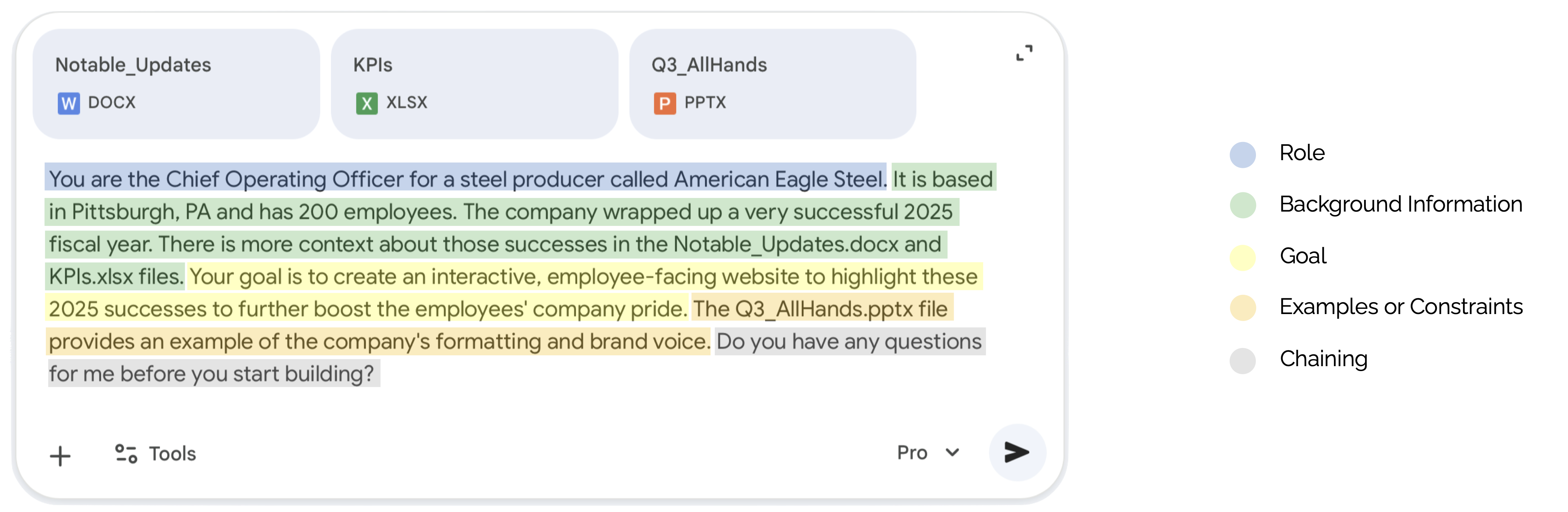
The problem is that generic AI prompts often yield generic AI outputs. While prompts don't necessarily have to be thousands of words long, providing some detailed context can make a substantial difference when it comes to getting the most out of AI. Below is a simple example of how to provide strong context to AI (and utilize multiple prompting techniques):
MCP Connectors
But what if the AI could gather that context automatically? That's the idea behind MCP (Model Context Protocol) Connectors. They connect AI directly to context-rich apps and data sources like a CRM, email, calendar, files, and more. The AI can pull in relevant context without the person having to manually copy and paste it in. But perhaps even more importantly, MCPs allow AI to take action in the real world, not just return responses. Instead of simply drafting an email, the AI can send it. Instead of suggesting a calendar invite, it can create one. MCPs transform AI from a helpful advisor into a capable assistant that actually gets things done.